How to Stop Your Pink Princess Philodendron Spots from Turning Brown
By David Sullivan | Published on August 10, 2026
Key Takeaways
- Pink Princess Philodendron brown spots usually start on the pink areas first because variegated tissue has less chlorophyll and breaks down faster under stress.
- The top triggers are low humidity, overwatering/root stress, and light mistakes (direct sun scorch or not enough bright indirect light)
- Brown tissue won’t turn pink again focus on stabilizing humidity, light, and watering (plus an airy aroid mix) so new leaves grow healthy and spot-free.
In This Article
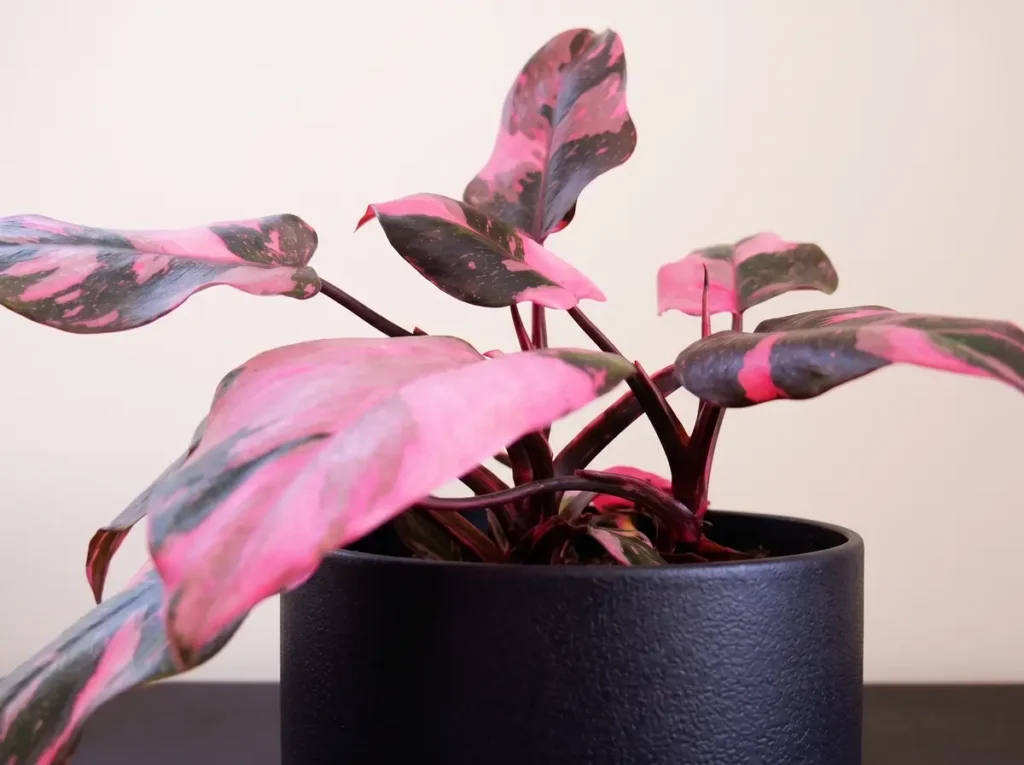
Pink Princess Philodendron is famous for its bubblegum-pink variegation but that same pink is the first part of the leaf to look “ugly” when conditions are even slightly off. If you’re dealing with pink princess philodendron brown spots, you’re not alone. Browning can happen quickly, and it’s especially frustrating because it often hits the pink sections first.
The good news : browning is usually a care mismatch you can correct. The better news: once you dial in the right routine, new leaves can come in cleaner and stay pretty longer.
The Science Behind Browning Pink Leaves
To understand why are my pink princess leaves browning, you need one key fact :
Pink (and white) variegation contains less chlorophyll than green tissue.
Chlorophyll is the plant’s “solar panel” Green areas can photosynthesize efficiently and tend to be tougher. Pink areas have less energy production and less protective pigment, so they’re more sensitive to:
- dry air (they dehydrate faster),
- excess moisture at the roots (they rot faster),
- harsh sun (they scorch faster),
- low light (they starve first).
That’s why pink princess pink leaves turning brown is so common even when the green parts look “mostly fine” The pink is basically the plant’s luxury feature beautiful, but expensive to maintain.
4 Main Causes of Brown Spots (and How to Fix Them)
1) Low Relative Humidity (Crispy brown edges on pink)
If the brown areas feel dry, crispy, and papery, low humidity is a top suspect especially in winter or if the plant sits near a vent.
Why it happens
Pink tissue loses moisture faster. In dry air, the pink sections can’t stay hydrated, so they crisp at the edges or develop scattered brown patches.
What it looks like
- Brown, crunchy tips and margins (often on pink first)
- Edges that curl slightly
- Leaf looks thinner or “tired” even if the plant is otherwise okay
Fix it
- Target 50–60%+ humidity for best-looking variegation. (This is the “sweet spot” for many aroids.)
- Use a small humidifier near the plant (the most effective option).
- Move the plant away from HVAC airflow (forced air can undo your humidity efforts).
- Group plants together to create a more humid micro-zone.
Important note: misting is usually not enough. It raises humidity for a few minutes, then the air returns to dry. It can also leave water spots and doesn’t solve the root cause.
This is the most direct answer to pink princess philodendron humidity problems: you don’t need a jungle—just stable humidity and no vent blasts.
2) Overwatering and Early Root Rot (Soft brown, spreading patches)
If brown spots look dark, soft, or “wet” or if the leaf yellows around the brown area, suspect root stress from overwatering.
Why it happens
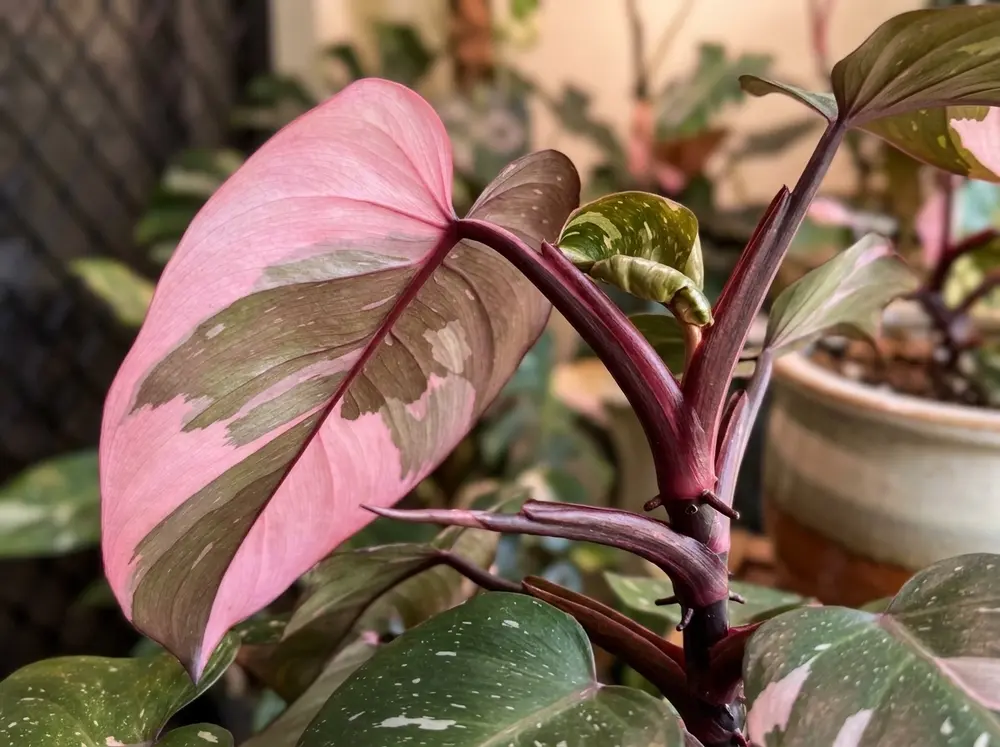
When the potting mix stays wet too long, roots can’t breathe. Stressed roots can’t move water and nutrients properly. Variegated tissue suffers first, and you’ll see browning that may look like rot or bruising on the pink sections.
What it looks like
- Brown spots that are soft or mushy
- Yellowing spreading outward from a spot
- Drooping even though soil is wet
- Musty smell, fungus gnats, or slow growth
Fix it
- Don’t water by schedule. Water only when the mix is dry enough for an aroid: typically when the top few inches are dry and the pot feels noticeably lighter.
- Confirm your pot has drainage holes and you’re not leaving water in the saucer/cachepot.
- Upgrade to a chunky aroid mix (more on that below).
- If you suspect rot: slide the plant out and inspect roots. Healthy roots are firm and light-colored; rotted roots are dark, mushy, and may smell sour. Trim rot and repot in fresh mix.
If your browning is accompanied by droop + wet soil, the “fix” is not more water it’s drying and root recovery.
3) Direct Sunburn vs. Low-Light Stress (Both can brown pink)
Light issues are tricky because both too much and too little light can end in browning.
Direct sunburn (too much)
Pink areas can scorch faster than green when hit by harsh direct sun, especially through glass.
What it looks like :
- Brown patches on the window-facing side
- Bleached, faded, or tan spots that later turn crispy
- Damage appears soon after moving to a brighter window
Fix it :
- Move the plant out of direct sun or filter light with a sheer curtain.
- Keep bright light, but make it indirect.
Low-light stress (too little)
In low light, variegated leaves can’t “pay for themselves.” The plant struggles to support pink tissue, and you may see browning plus weak growth.
What it looks like :
- Smaller leaves, longer internodes (stretching)
- Variegation becomes patchier or less vibrant
- Pink areas brown slowly, plant growth stalls
Fix it :
- Move closer to a bright window (without direct sun).
- Use a grow light if your home is dim, especially in winter.
If you want an easy rule: Pink Princess likes bright indirect light strong enough to cast a soft shadow, but not direct rays hitting the leaf for hours.
4) Stuck Emerging Leaves (Brown scarring on new growth)
Sometimes browning isn’t humidity or watering it’s mechanical damage during unfurling.
Why it happens
New leaves can get stuck in the cataphyll (the protective sheath). As the leaf struggles to open, it tears or creases, and those damaged areas turn brown as they heal.
What it looks like
- Browning on the newest leaf, often along a crease line
- Tears, dents, or distorted shape
- Brown scarring that doesn’t “spread” like disease
Fix it
- Increase humidity around the plant (this is one time humidity helps immediately).
- Avoid yanking the leaf open. If it’s truly stuck, you can gently support the leaf and very lightly loosen the sheath with clean, damp fingers but be patient and careful.
- Make sure the plant is not drying out too much between waterings (extreme dry-down can worsen stuck leaves).
Stuck leaves are one of the most common “mystery” causes when someone asks how to save browning pink princess leaves and they swear watering/light are fine.
Step-by-Step Recovery Routine for Damaged Leaves
This routine is designed to stop the spiral: stress → browning → more stress → worse browning. Do the steps in order and avoid changing everything at once.
Step 1 : Diagnose the brown (crispy vs soft)
- Crispy, dry = humidity/light/watering inconsistency
- Soft, wet, spreading = overwatering/root stress or infection
This one observation tells you where to focus first.
Step 2 : Stabilize watering (your highest impact move)
- Check soil moisture deeper than the surface.
- Water thoroughly only when it’s time, then drain completely.
- If your plant is in low light, expect watering to be less frequent.
Most cases of pink princess philodendron brown spots either start with or get worse from watering mistakes.
Step 3 : Fix the environment (humidity + drafts + temperature)
- Aim for 50–60%+ humidity if possible.
- Keep away from vents and cold drafts.
- Maintain steady room temps (tropical plants hate swings).
Step 4 : Adjust light without shocking the plant
- Bright indirect is ideal.
- If moving brighter, do it gradually over 7–10 days.
- If using a grow light, start with shorter exposure and increase.
Step 5 : Upgrade the soil mix if drying is slow
A Pink Princess thrives in an airy aroid mix. If your current soil stays wet too long, switch to something chunkier that drains and breathes.
A practical “chunky” direction (not a strict recipe) :
- quality potting mix as the base,
- add orchid bark for structure,
- add perlite/pumice for drainage.
The goal is a mix that gets wet thoroughly, then dries predictably without turning to sludge.
Step 6 : Prune brown areas the right way (optional, cosmetic)
Brown tissue won’t turn pink again. You can trim for looks, but don’t “chase perfection” by removing too much leaf area.
- If only tips are brown : trim the crispy edge with clean scissors following the natural leaf shape.
- If a leaf is more than half damaged or looks diseased: remove the whole leaf at the petiole to redirect energy to new growth.
Step 7 : Don’t fertilize a stressed plant
If your plant is actively declining, fertilizing can add salt stress. Wait until you see stable growth, then feed lightly during active seasons.
Frequently Asked Questions
Will the brown spots ever turn pink again ?
No. Once tissue turns brown, it’s dead. Your win is healthier new growth and slowing further browning.
Should I cut off a leaf that is half brown ?
If more than 50% is damaged, or if the brown area is soft/spreading, removing the leaf can help the plant focus on new growth. If the leaf is still mostly healthy and the browning is stable (crispy and not spreading), you can keep it until the plant replaces it naturally.
Why are my pink princess leaves browning even though I water correctly ?
Two common reasons :
- Humidity is too low or the plant is in vent airflow.
- Light is mismatched (either too much direct sun or too little bright indirect).
Also consider water quality : mineral-heavy water can contribute to browning edges over time.
What humidity does a Pink Princess Philodendron need ?
It can survive at normal household humidity, but for the best-looking variegation and fewer brown edges, aim for 50–60% or higher. That’s the practical answer to pink princess philodendron humidity concerns.
How to save browning pink princess leaves fast ?
You can’t “repair” brown tissue, but you can prevent it from worsening fast :
- Remove direct sun
- Stop overwatering and improve drainage
- Raise humidity and remove vent drafts
- Keep conditions stable so the next leaf emerges clean